
Generate the fifty hooks from a structured set of audience problems, objections and demonstration ideas, then remove duplicates and unsupported promises. Treat fifty as an exploration target, not fifty ready-to-launch ads. Review the strongest distinct concepts before producing video versions.
A request for fifty hooks often returns the same sentence with different adjectives. Better inputs create useful variety: who the product serves, what they struggle with, what the product actually does and what evidence is available. Build the idea space before asking for the wording.
Step by step
Prepare a product truth sheet
List approved capabilities, limitations, offer terms and evidence. Include real customer language from authorized sources where available. Mark claims that are not supported so they cannot be used as shortcuts to dramatic copy.
Choose five meaningful angles
For a workflow tool, possible angles are ownership, status visibility, handoff clarity, setup understanding and review coordination. Confirm that each reflects the product. Do not create angles solely from vague emotions or unsupported outcomes.
Define ten expression approaches
Use forms such as a question, visible problem, demonstration, contrast, objection answer or specific task. Avoid forcing every form if it creates awkward copy. Five angles times ten approaches is a brainstorming structure, not a requirement to keep every result.
Draft the hooks with first frames
Pair each line with what the viewer sees. Keep the promise narrow enough for the body to fulfill. Reject hooks that depend on fake customer proof, invented percentages or a feature outside the truth sheet.
Cluster and score the set
Group near-duplicates and judge relevance, clarity, credibility and compatibility with a body. Use a simple review scale consistently. Select a small set of genuinely different hypotheses rather than the ten most aggressively worded lines.
Produce and learn from the shortlist
Create the approved openings in Golpo with stable downstream modules. Label the assets and test according to campaign capacity. Feed results and unanswered questions back into the hook library without pretending all fifty were validated.
The workflow inside Golpo
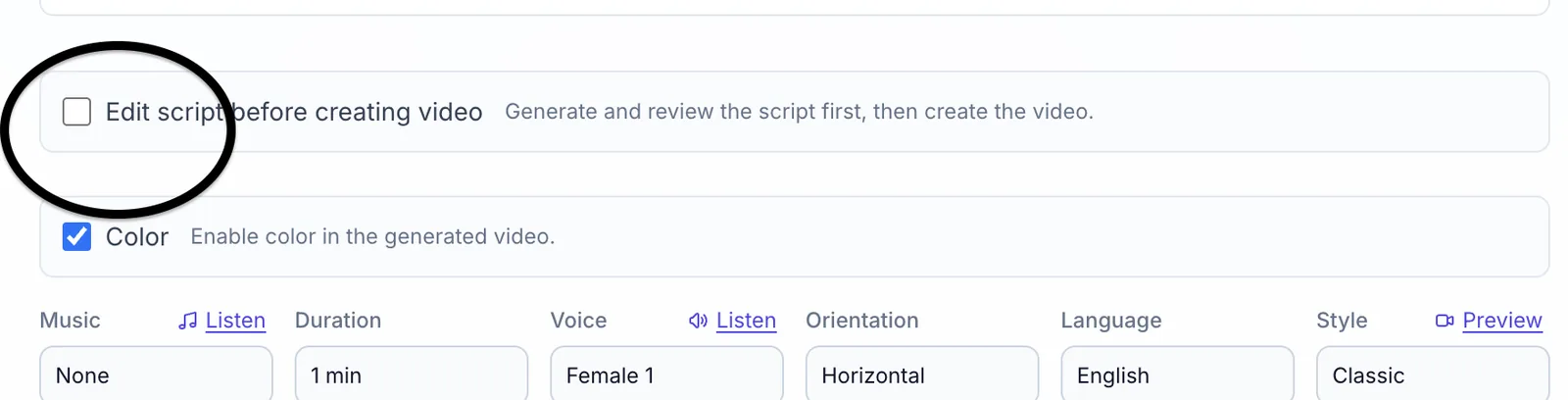
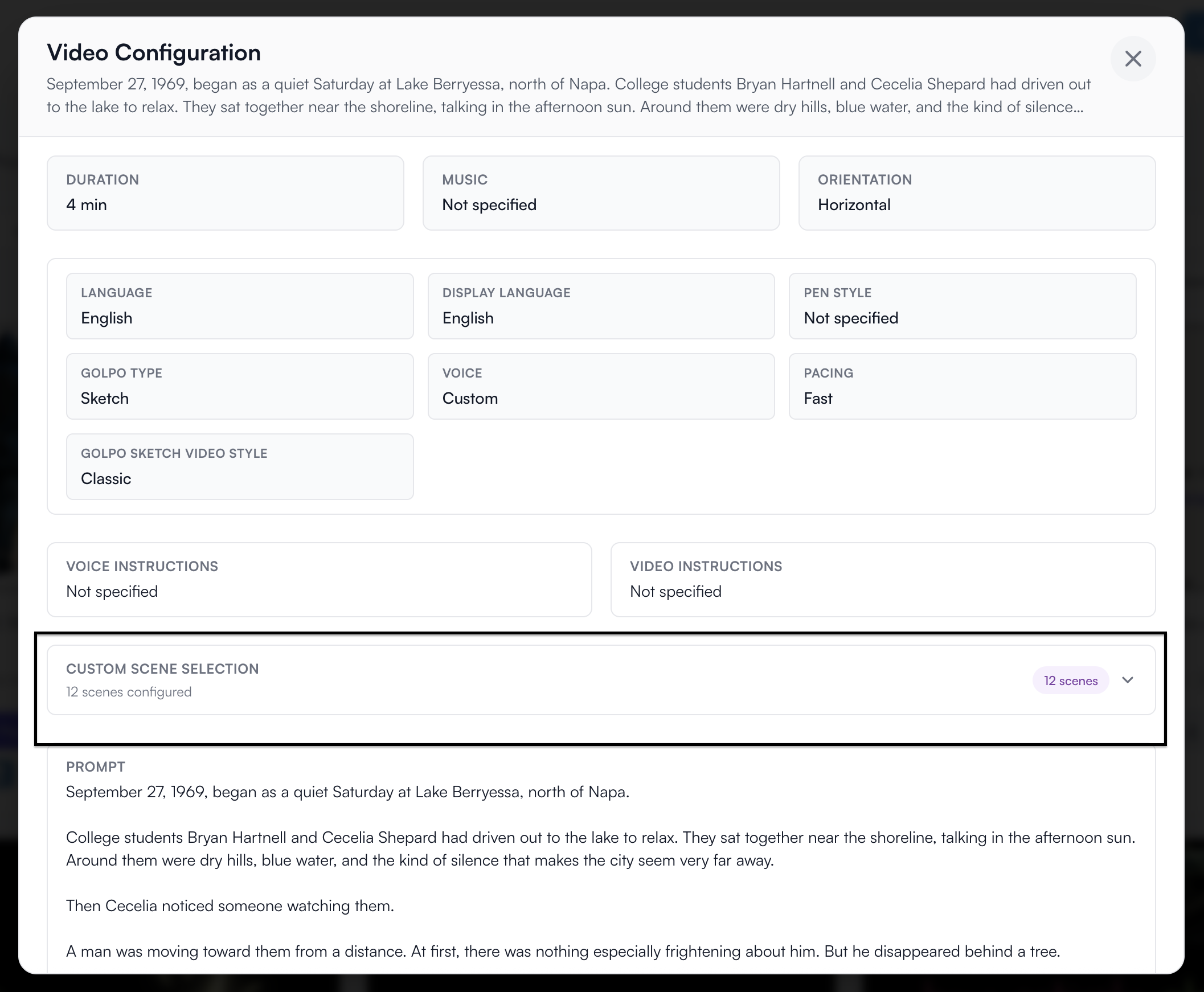
Use these real interface views to find the creation and review controls. Apply the decisions from this guide to your own brief, then review the resulting script and visuals before publishing.
Use constraints to improve variety
Asking for different verbs rarely produces different ideas. Asking one hook to demonstrate setup and another to answer an ownership objection creates substantive variation. Keep the product mechanism as the anchor so creativity does not drift into fiction.
Retain rejected ideas with reasons
A hook may be rejected because it is unsupported, redundant or poorly matched to the audience. Recording the reason prevents the same issue from returning in the next brainstorming batch. Revisit an evidence-blocked idea only when the evidence becomes available.
Five angles, ten approaches
The worksheet creates fifty candidate positions, then removes invalid and repetitive options. Only the reviewed shortlist becomes video assets.
Generate a fifty-candidate hook worksheet for a fictional workflow tool using five verified angles: ownership, status visibility, handoff clarity, setup understanding and review coordination. Explore ten distinct expression approaches across the angles, pairing each line with a first-frame idea. Use only supplied product facts. Do not invent customer results, urgency or numerical savings. Group near-duplicates, mark unsupported candidates rejected and propose a small diverse shortlist. Include a reason for each selection and a body-compatibility note; do not call any hook proven before testing.
Before you publish
- Truth sheet prepared
- Angles distinct
- Visuals paired
- Duplicates removed
- Shortlist reviewed before production
Now, make it yours.
Start with a prompt, bring your script, or turn document text into a video.
You’ll review the setup in Golpo.
Sign-in and plan limits apply.
Your complete text is ready. It is too long to send reliably in a link. Copy it, open Golpo, and paste it into the prompt or script field.
Open GolpoCommon questions
Should all fifty be tested?
No. The number supports exploration. Testing volume should follow useful hypotheses, budget and evidence capacity.
Can I use the same hook across products?
Reuse the underlying structure only when the new product can truthfully fulfill the promise and the audience context fits.
Sources & useful reading
Published November 24, 2026. Product features and platform policies can change; linked official documentation is the source for current availability. Examples are illustrative production briefs.